




Mechanical properties of equipment power PCB board
Aug 10, 2026
Leave a message
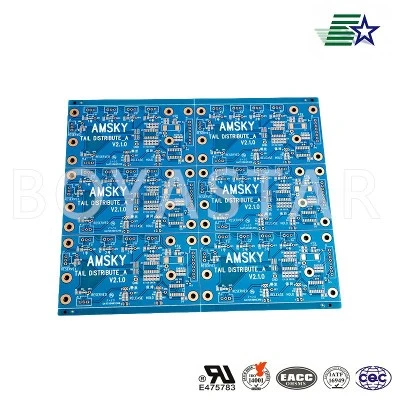
The mechanical stability of the equipment power PCB is the core guarantee for the reliable operation of power equipment. Compared with ordinary signal circuit boards, power boards are equipped with heavy-duty components such as power tubes, large volume electrolytic capacitors, transformers, etc. The load-bearing pressure on the board surface is greater, and the requirements for the structural strength of the board are also higher. The vast majority of industrial and commercial equipment power PCBs on the market use FR-4 epoxy glass cloth boards, relying on the three-dimensional support structure of internal glass fibers to give the boards sufficient rigidity and structural toughness. The biggest advantage of this substrate is its excellent dimensional stability. In the face of temperature and humidity fluctuations in daily environments, it is not prone to deformation problems such as stretching and warping. It can always maintain a flat and regular surface, effectively avoiding common faults such as line deviation, solder joint pulling and cracking, and poor circuit contact caused by board deformation, and laying a solid hardware foundation for stable operation of power circuits.
The resistance to vibration, impact, and bending deformation is a key mechanical characteristic of power PCB adaptation equipment for complex working conditions. During the operation of industrial equipment, outdoor equipment operations, and equipment transportation and handling, vibrations, bumps, and instantaneous mechanical impacts will continue to occur. Long term effects on the PCB surface can easily cause problems such as virtual soldering of components, pin breakage, and delamination and detachment of the board. To adapt to such working conditions, power PCB generally adopts the production process of thick substrate and thick copper foil to enhance the overall bending and deformation resistance of the board. In terms of structural design, the industry will also optimize the layout accordingly, placing heavier power devices near the fixed holes on the board edge. By increasing the number of fixed points and optimizing the force structure on the board surface, stress can be dispersed to avoid local force concentration, allowing the circuit board to withstand various mechanical external forces caused by assembly locking, equipment start stop, and long-term vibration, and adapt to long-term continuous operation work scenarios.
The stress tolerance and structural durability performance determine the long-term service life of the equipment power PCB. The power board is the core component of equipment that operates 24/7. During the working process, the power devices continue to heat up, and the equipment starts and stops, as well as changes in ambient temperature, cause the circuit board to repeatedly undergo cold and hot cycles, resulting in the board being subjected to the dual effects of thermal stress and mechanical stress. In the long run, it is prone to problems such as board fatigue, decreased interlayer adhesion, and material softening. Regular power PCB will enhance interlayer bonding strength through high standard lamination process, effectively resist stress impact caused by temperature cycling, and prevent copper foil detachment and board delamination. At the same time, the board has the characteristic of low water absorption, which can resist the erosion of humid environments, avoid the mechanical performance degradation caused by material softening due to moisture, and ensure that the circuit board always maintains a stable mechanical structure state under complex working conditions of high and low temperatures, dry and wet alternation, greatly improving the overall durability of power equipment.
Send Inquiry