




Physical properties of lighting PCB board
Aug 16, 2026
Leave a message
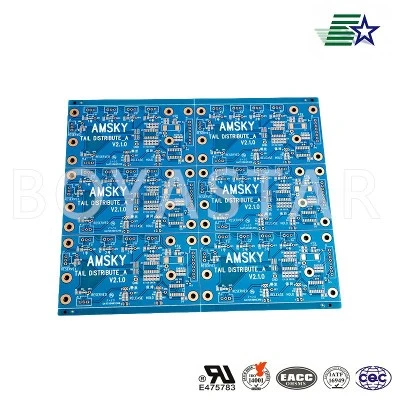
The physical properties of the basic structure of lighting PCB boards are mainly reflected in the rigidity, flatness, and structural stability of the board, which are the foundation for long-term stable assembly and use of lighting fixtures. Conventional lighting PCBs on the market often use standard FR-4 or aluminum substrates. The overall hardness of the board is uniform and not easily deformed, which can adapt to the installation needs of various flat, circular, and irregular structures of lamps. The board surface has high flatness and no defects such as warping, twisting, unevenness, etc., which can ensure that the light beads, resistors, capacitors and other components are firmly attached, and it is not easy to encounter assembly problems such as virtual soldering and misalignment after welding. At the same time, the dimensional accuracy of the board is stable, and there will be no significant expansion or contraction deformation under normal temperature changes. It can adapt to batch production assembly standards, ensuring the structural fit and appearance regularity of each lamp.
Heat resistance and thermal conductivity are the core physical indicators of lighting PCBs, which directly determine the heat dissipation efficiency and service life of the lamps. Lighting fixtures belong to products that work continuously with electricity for a long time. When the lamp beads emit light, they will continue to generate heat, which requires high temperature resistance and thermal conductivity of the board. Ordinary indoor lighting FR-4 board has good heat resistance and flame retardant properties, can withstand conventional working temperatures and is not easily softened or carbonized, meeting daily lighting needs; The aluminum substrate used in high-power outdoor lighting and industrial and mining lighting has excellent thermal conductivity properties, which can quickly conduct and diffuse the heat accumulated by the lamp beads, reduce the working temperature of the lamp beads, and effectively alleviate light decay and flicker phenomena. Stable thermophysical properties can avoid board aging and performance degradation caused by long-term high-temperature work, greatly improving the durability of lighting fixtures.
Send Inquiry